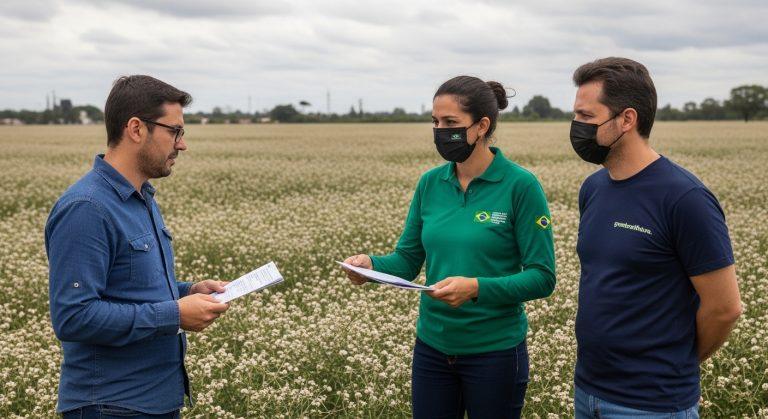

A broad view of the Amazon rainforest with rivers and signs of conservation and sustainable agriculture.
Updated: April 9, 2026
In a moment when policy experimentation and capital allocation intersect, Brazil stands at a critical juncture where climate ambition, market signals, and local livelihoods collide. This analysis foregrounds brazil Environment Brazil as a frame for understanding how Lula’s administration seeks to mobilize finance, steer development, and protect forests while pursuing growth. The questions are not merely technical: they are about governance, equity, and the tempo at which Brazil can translate lofty commitments into tangible outcomes for communities, ecosystems, and industries across the country.
Rationale behind Lula’s $50 billion green push
Brazil’s current term has centered on mobilizing nearly $50 billion in sustainable investments, drawing on a mix of public funds, state banks, and private capital. The ambition rests on decarbonizing transport, power, and industry, while tying fiscal support to measurable forest protections and regional development. Proponents argue that a well-structured mix of subsidies, low-interest credit, and performance-based incentives can bend the curve toward a low-emission growth path without sacrificing jobs or regional integration. Critics, however, warn that capital may flow toward projects with opaque governance, weak social safeguards, or limited local participation. In this frame, the question is whether Lula’s plan can synchronize policy design with on-the-ground realities—land tenure, indigenous rights, and smallholder inclusion—without diluting environmental safeguards in pursuit of rapid scale.
At its core, the push seeks to align Brazil’s climate targets with broader social and economic goals, weaving together energy transition, sustainable agriculture, and green infrastructure. The strategy contends that public investment can de-risk private finance, crowd in international capital, and accelerate the deployment of wind and solar, as well as smarter grid management. Yet the pathway requires credible metrics, transparent procurement, and clear accountability—factors that often determine whether large fiscal commitments translate into durable environmental and social gains or into stranded assets and misplaced incentives.
Finance, policy design, and market risk
The financing architecture for Brazil’s green push blends budgetary allocations, development bank lending, and blended finance mechanisms intended to lower the cost of capital for green projects. In practice, this means a prominent role for institutions like BNDES and other state-backed instruments that can absorb risk and signal long-term commitment. Policy design matters as much as funding size: streamlined permitting, predictable tariff regimes, and standardized carbon accounting are crucial for reducing transaction costs and boosting confidence among domestic and international investors. But market sentiment in some quarters has grown wary. A notable portion of Brazilian business leaders has expressed rising pessimism about climate-related outcomes by 2026, underscoring concerns about regulatory consistency, policy continuity, and the timing of measures that truly unlock private capital at scale. The tension between ambitious targets and near-term fiscal constraints illustrates the broader governance challenge: turning policy rhetoric into durable, bankable projects requires credible rules, robust verification, and transparent impact reporting.
Moreover, the ownership of risk matters. If financing remains skewed toward large, visible projects without inclusivity or meaningful local benefits, the program risks uneven regional development and social friction. Conversely, a program that anchors credit in small and medium-sized enterprises, cooperatives, and rural communities can broaden impact but demands stronger capacity-building, technical assistance, and risk-sharing. The balance between risk transfer to private investors and social risk protection will shape both the speed and the equity of Brazil’s green transition.
Impacts on communities and ecosystems
Green investments carry the potential to reduce deforestation, improve air and water quality, and create new livelihoods in rural regions. For forest-dependent communities, the alignment of policy with land rights and neighborhood-level benefits is essential. Targeted investments in agroforestry, regenerative farming, and forest-friendly infrastructure can bolster resilience against climate shocks while expanding markets for sustainable products. Yet the risk of uneven gains remains real: if benefits accrue mainly to large landholders or urban-based manufacturers, smallholders and indigenous groups may face persistent inequities or loss of bargaining power. Policies that tie funding to transparent benefit-sharing, enforce land-tenure clarity, and support local capacity-building are, therefore, not ancillary but central to the success of the program. Ecosystem health also hinges on credible deforestation monitoring, credible enforcement of environmental licensing, and protection of biodiversity—areas where implementation gaps can undermine the environmental integrity of otherwise laudable investment programs.
In practice, the success of these investments will depend on integrating environmental safeguards with social outcomes. Monitoring frameworks that track forest cover, water quality, and community benefits in near real time can provide early feedback, allowing adjustments before projects become misaligned with ecological limits. For Brazil, the test is whether policy coherence can translate into a measurable decline in deforestation rates, improved rural incomes, and a resilient energy transition that does not come at the expense of vulnerable populations or fragile ecosystems.
Regulatory horizons and forest governance
Regulatory clarity and governance quality are the linchpins of credible green finance. Brazil’s regulatory horizons include strengthening forest codes, expanding protected areas where appropriate, and building strong, independent monitoring of emissions and deforestation. The long-term credibility of the green investment push depends on consistent enforcement, credible data, and the absence of policy surprise that could deter investors. Indigenous rights, land tenure security, and the inclusion of smallholders in value chains are not only social obligations but practical prerequisites for sustainable outcomes. A governance framework that blends top-down safeguards with bottom-up participation enhances both trust and efficiency, enabling a transition that respects local contexts while delivering national climate benefits.
Decarbonization efforts must also account for leakage risks and ensure that carbon-market mechanisms do not substitute for tangible, on-the-ground improvements. In parallel, transparent procurement practices, rigorous project appraisal, and independent auditing will be essential to prevent misallocation of funds and to maintain investor confidence. The governance architecture will ultimately determine whether Brazil’s green finance push produces lasting, inclusive development or a series of well-funded but unevenly distributed initiatives.
Actionable Takeaways
- Embed transparent governance and impact metrics in every funded project, with public dashboards showing forest outcomes, emissions reductions, and community benefits.
- Prioritize access to green credit for smallholders, cooperatives, and indigenous groups, coupling financing with capacity-building and technical assistance.
- Link funding to credible land-tenure reforms and community consultation to ensure equitable distribution of benefits and reduced conflict over resources.
- Develop a diversified financing mix that blends public funds, concessional lending, and private capital, while clearly allocating risk-sharing responsibilities.
- Strengthen monitoring, verification, and reporting with independent audits and open data to build investor confidence and public trust.