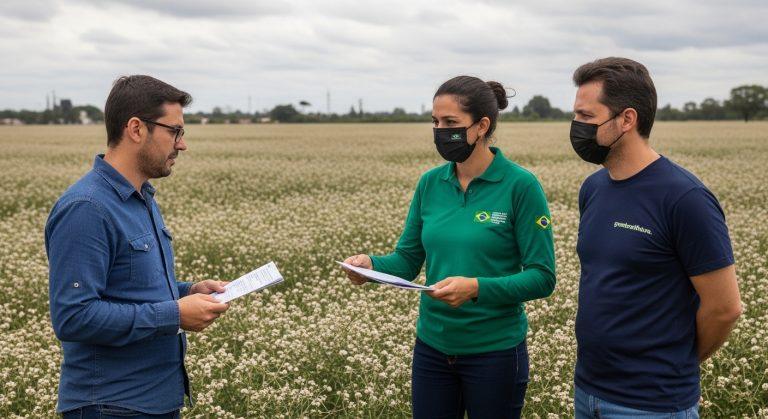

Aerial view of the Brazilian Amazon with rivers, forest, and small sustainable farms illustrating climate resilience.
Updated: April 9, 2026
At a time when the world watches environmental Environment Brazil policy as a pivot point for climate resilience and biodiversity, Brazil stands at a crossroads between growth, conservation, and social equity. This analysis weighs how governance, funding, and enforcement shape outcomes for forests, rivers, and the communities that depend on them, and why the next decade matters for the country’s ecological and economic future.
Context and Drivers
Over the past decade, Brazil has oscillated between ambitious environmental commitments and policy shifts that affect enforcement, land use, and resource management. The federal framework for environmental protection remains essential for guiding licensing, monitoring, and penalties for illegal activities. Yet budget pressures, political contestation, and regional sovereignty concerns have influenced how these protections are implemented on the ground. Deforestation pressures in the Amazon and related ecosystems continue to reflect a mix of agricultural expansion, infrastructure development, and demand for natural resources, moderated by local governance, law enforcement capacity, and community stewardship. In this context, climate goals intersect with development strategies in a country whose cultural and geographic diversity requires nuanced, place-based policy responses. The central question is whether the governance architecture can translate high-level commitments into durable protections that local actors can rely on, even when market incentives push in the opposite direction.
Key dynamics include the interplay between environmental licensing, Indigenous and traditional community land rights, and the role of public institutions in monitoring and enforcement. As global finance and trade increasingly prize sustainable credentials, Brazil’s ability to demonstrate verifiable progress becomes a potential source of competitive advantage for export-oriented sectors, while also serving as a model for subnational laboratories of reform. The outcome will depend not only on law on the books, but on how institutions adapt to resource pressures, how data transparency is advanced, and how civil society engages with policy design and implementation.
Risks and Opportunities
Brazil faces a dual risk: environmental degradation that undermines long-term resilience, and social disruption if communities bear the costs of policy choices without commensurate protection or compensation. The risks are amplified by fragmented governance across federal, state, and municipal levels, which can yield uneven enforcement and incentives that favor short-term gains over longer-term sustainability. At the same time, there are meaningful opportunities to align growth with conservation through vectoring investments toward nature-based solutions, sustainable land use, and improved water management.
Opportunities include leveraging carbon markets and nature-positive finance to reward preservation and restoration, expanding integrated watershed management, and strengthening land tenure clarity to reduce conflict and illegal encroachment. Private sector actors, local cooperatives, and Indigenous organizations can become important partners if policy frameworks provide credible standards, transparent metrics, and accessible dispute resolution mechanisms. The challenge is to elevate governance capacity so that environmental safeguards are not treated as ancillary but as core components of Brazil’s development strategy, with measurable benchmarks and accountability across all levels of government.
Scenarios for 2030
Three plausible trajectories illustrate how decisions taken today could unfold by 2030. First, the status quo scenario emphasizes incremental reform, with stronger enforcement in some regions and continued patchwork in others. In this path, gains in forest monitoring and water management occur alongside persistent enforcement gaps, producing uneven outcomes across ecosystems and communities. Second, a reform-led scenario envisions a more coherent governance framework: better data integration, greater institutional autonomy for environmental agencies, and expanded Indigenous and community participation in land-use decisions. This path could yield more consistent protections and gradually shift incentives toward sustainable practices, though it would require sustained political capital and reliable funding. Third, a disruption scenario reflects sudden policy shifts—whether through fiscal consolidation, shifts in political leadership, or securitized resource conflicts—that could either accelerate reforms under pressure or trigger rollback of protections. In such a climate, resilience hinges on resilient institutions, diversified funding, and broad civil society engagement that can withstand volatility.
Across these futures, technology and transparency will be crucial levers. Remote sensing, open-data platforms, and independent reporting can reinforce accountability, while targeted programs that align livelihoods with conservation goals can help communities transition away from environmentally adverse practices. The most plausible path combines steady governance improvements with responsive, locally adapted strategies that recognize Brazil’s regional diversity, ecological complexity, and social realities.
Actionable Takeaways
- Strengthen funding and autonomy for environmental agencies to increase enforcement coverage in high-risk regions without sacrificing due process or community rights.
- Scale up data sharing and independent auditing for forest and water baselines, enabling timely enforcement and more credible sustainability reporting for businesses and policymakers.
- Expand inclusive land-use planning that recognizes Indigenous and traditional community territories, balancing development with protected-area networks and restoration needs.
- Encourage private-public partnerships focused on nature-based solutions, sustainable supply chains, and watershed restoration that align with local livelihoods and climate objectives.
- Promote transparent dispute resolution that reduces litigation lead times and ensures that communities have meaningful recourse when environmental protections are at risk.
Source Context
To provide context for this analysis, readers can review recent reporting on environmental governance and policy debates in Brazil: